
A Guide to Hong Kong-Bound Food Labels (Part 2): The
2026-11-03 to 2026-11-04Hong Kong's nutrition labelling regulations are more complex than those on the Mainland. The "1+7" nutrition label is a statutory nutrition labelling system for prepackaged food in Hong Kong, which requires the content of 1 type of energy and 7 specified nutrients to be listed in tabular form on the packaging.
Hong Kong's nutrition labelling requirements are stricter than those on the Mainland, which is why many Hong Kong-bound manufacturers easily make mistakes on this requirement.
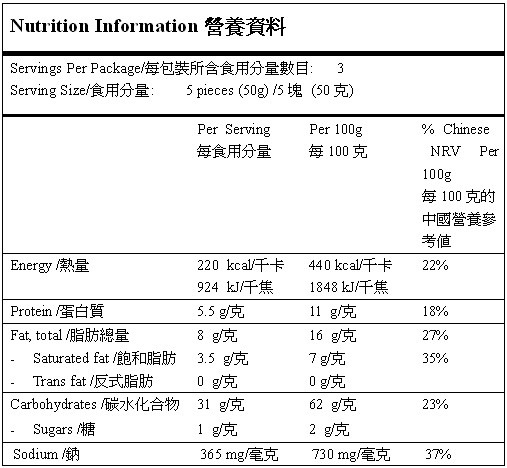
I. "1" — Energy
According to Codex Alimentarius Commission standards, the energy value is calculated from protein, total fat, available carbohydrates, etc.; ethanol and organic acids, if present, must also be included. Dietary fibre does not participate in the energy calculation. The conversion factors for each nutrient are as follows:
Protein: per gram × 17 kJ (approx. 4 kcal)
Total fat: per gram × 37 kJ (approx. 9 kcal)
Available carbohydrates (total carbohydrates minus dietary fibre): per gram × 17 kJ (approx. 4 kcal)
Dietary fibre: Does not participate in energy calculation.
Ethanol (if present): per gram × 29 kJ (approx. 7 kcal)
Organic acids (if present): per gram × 13 kJ (approx. 3 kcal)
In Hong Kong, the energy value of food can be declared in kilocalories (kcal) or kilojoules (kJ), or both, which is different from the Mainland requirement where only kilojoules (kJ) are mandatory.
II. "7" — Seven Core Nutrients
1. Protein
Determined by the Kjeldahl method and calculated by nitrogen content × 6.25. The requirements are consistent in both Hong Kong and the Mainland.
2. Total Fat
The testing method for this item is the same in Hong Kong and the Mainland, although in the Mainland this item is referred to as "Fat" (脂肪).
3. Saturated Fat
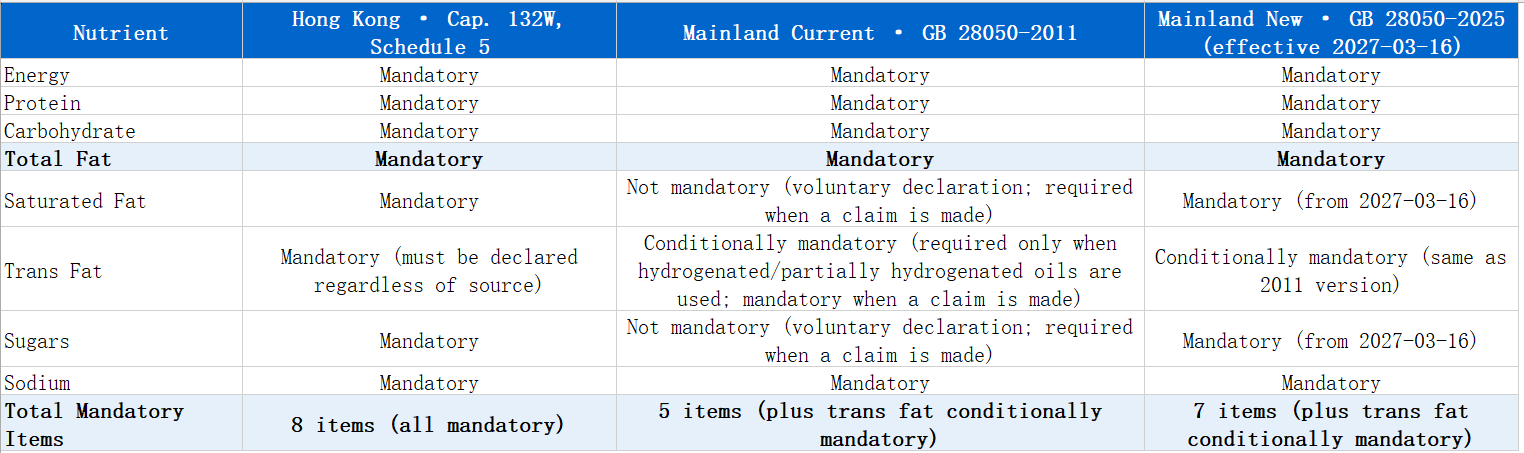
Mandatory labelling is required in Hong Kong; the Mainland only mandates it starting from the implementation of the latest National Food Safety Standard "General Standard for the Nutrition Labelling of Prepackaged Foods" on 16 March 2027.
4. Trans Fat
In the "General Standard for the Nutrition Labelling of Prepackaged Foods" implemented in the Mainland from 16 March 2027, this item remains a voluntary labelling item.
This is the item with the greatest difference between the two places. Trans fat is an unconditional mandatory labelling item in Hong Kong: even if it is naturally occurring trans fat, or if there is no fat at all in the ingredient list, the value must be declared.
The Mainland stipulates that the trans fat content should only be declared if the food ingredients contain or the production process uses hydrogenated and/or partially hydrogenated oils, or if a claim is made about trans fat.
Therefore, as long as food is supplied to Hong Kong, this item must be labelled.
5. Carbohydrates
Mandatory in both places. It is particularly important to note that the labelling name required in Hong Kong is "Carbohydrates", rather than "Total Carbohydrates" or "Carbs".
When calculating energy, Hong Kong strictly distinguishes between "total carbohydrates" and "available carbohydrates" (i.e., total carbohydrates minus dietary fibre).
If the label declares "Total Carbohydrates", Hong Kong legislation mandates the additional declaration of "Dietary Fibre" content, and dietary fibre must be deducted during energy conversion.
6. Sugars
Mandatory in Hong Kong, and the Mainland likewise mandates its labelling starting from 16 March 2027.
7. Sodium
Mandatory labelling in both the Mainland and Hong Kong. It should be noted that the declaration unit is milligrams (mg) / 100g or mg / 100mL.
III. Labelling Format
Labelling Basis
Two optional approaches:
Per 100g/mL: Applicable to all prepackaged foods.
Per serving: The specific weight/volume of the serving must be stated simultaneously, as well as the number of servings contained in the entire package. For example, for a 500g bag of pork jerky with a serving size of 100g, it should be labelled as: "Per serving 100g, this package contains 5 servings". Neither the specific serving nor the weight can be omitted.
Rounding of Values
Round according to Codex Alimentarius Commission (CAC) standards:
A common mistake: the testing laboratory provides the raw value (e.g., fat 2.34g), and the label copies 2.34g directly — but it should actually be rounded to 2.3g.
It is also particularly important to note that trans fat must be ≤0.3g/100g to be labelled as 0; this is one of the issues that easily arises.
Bilingual Requirements
If the label is bilingual, the nutrition label must correspond in both Chinese and English, and the English names must use statutory English terminology, not self-translated terms.
For example, "Sugars" must be used rather than "Sugar", and "Sodium" rather than "Natrium".
IV. Current Enforcement Situation: Why Are Nutrition Labels a High-Risk Area for Violations?
The Centre for Food Safety (CFS) in Hong Kong conducts annual sampling inspections of nutrition labels on prepackaged foods for sale. Common reasons for failure include:
False declaration of nutrients: The deviation between the declared value and the actual measured value exceeds the statutory tolerance limits (for energy, total fat, saturated fat, trans fat, cholesterol, sugars, sodium, etc., the measured value must not exceed 120% of the declared value; for protein, carbohydrates, dietary fibre, etc., it must not be lower than 80% of the declared value).
Omission of saturated fat: Enterprises do not send saturated fat for testing and directly label it as "0" or leave it blank.
Incorrect energy calculation: Failure to calculate according to statutory conversion factors, or directly using the tested value as the label value.
V. Practical Advice: From Testing to Labelling
Confirm items before sending for testing: Clearly instruct the laboratory to "test according to Hong Kong 1+7".
Check the test report: Confirm that saturated fat, trans fat, and sugars all have values — routine Mainland testing may not include them.
Rounding of values: Process raw data according to rounding rules; do not copy the test report verbatim.
Label layout: Use a tabular format with Chinese and English corresponding, and units unified as mg/100g (or mg/100mL).
Test before making claims: If you plan to make nutrition claims, first confirm that the measured values meet the statutory thresholds before writing the copy.
Label compliance, qualification filing, system building, residue testing, and channel matchmaking — every link in supplying Hong Kong and going global requires professional judgement. If your enterprise has plans to supply Hong Kong, you are welcome to contact us. We start with a free compliance assessment to help you clarify your current situation, calibrate your direction, and then formulate a step-by-step implementation plan.