
The “Mainland Palate” of Hong Kong Drifters Is Feeding Hong Kong’s Next Food Trend
2026-10-02 to 2026-10-03The “Mainland palate” of hundreds of thousands of Hong Kong drifters is feeding Hong Kong’s next food trend.
On 16 September, Hong Kong published its first five-year plan since the handover. “Building a highland for international high-end talent” was listed as one of five major objectives, and the cap on non-local undergraduate places will be raised to 50% from the 2026/27 academic year.
Over the past three years, more than 410,000 people have been approved to settle in Hong Kong, with Mainlanders forming the overwhelming majority. In the 2025/26 academic year, the number of non-local students enrolled in Hong Kong universities reached 108,600, a roughly 1.3-fold increase over seven years, with Mainland students accounting for the vast majority. At the University of Hong Kong alone, Mainland students make up 86.8% of non-local students.
Beyond the resident increase, there is also mobile traffic. According to the Hong Kong Tourism Board, visitor arrivals in 2025 reached 49.9 million, up 12% year on year, of which 37.8 million were Mainland visitors, accounting for 76%. Overnight visitors stayed an average of 3.1 nights — and eating is a necessity every night.
Tourism, study, staying in Hong Kong, putting down roots — this chain delivers tens of thousands of young “Mainland palates” to Hong Kong every year.
The culinary gap between Hong Kong and the Mainland is considerable. The tasty bites once readily available on the streets of Wuhan, Changsha and Chengdu are hard to find in Hong Kong. However prosperous Hong Kong may be, it cannot soothe a wanderer’s homesickness in the middle of the night.
This is an unmet rigid demand, and an increasingly certain incremental market taking shape at pace.
For Mainland food manufacturers, the real pain point has never been that products are not good enough, but that the Mainland market is too crowded: homogenisation, price wars and high channel costs make growth increasingly difficult. Yet at the same time, this new cohort in Hong Kong — high-income, young and equipped with a “Mainland palate” — is spending real money in search of familiar flavours.
While you are still watching, others have already acted.
Huashan Technology, a crayfish processing enterprise in Qianjiang, Hubei, has partnered with Bar Pacific, Hong Kong’s largest bar chain, to ship the taste of home to Hong Kong ahead of the crowd.
The first channels, the first scenarios and the first consumer mindshare are being rapidly occupied by first movers.
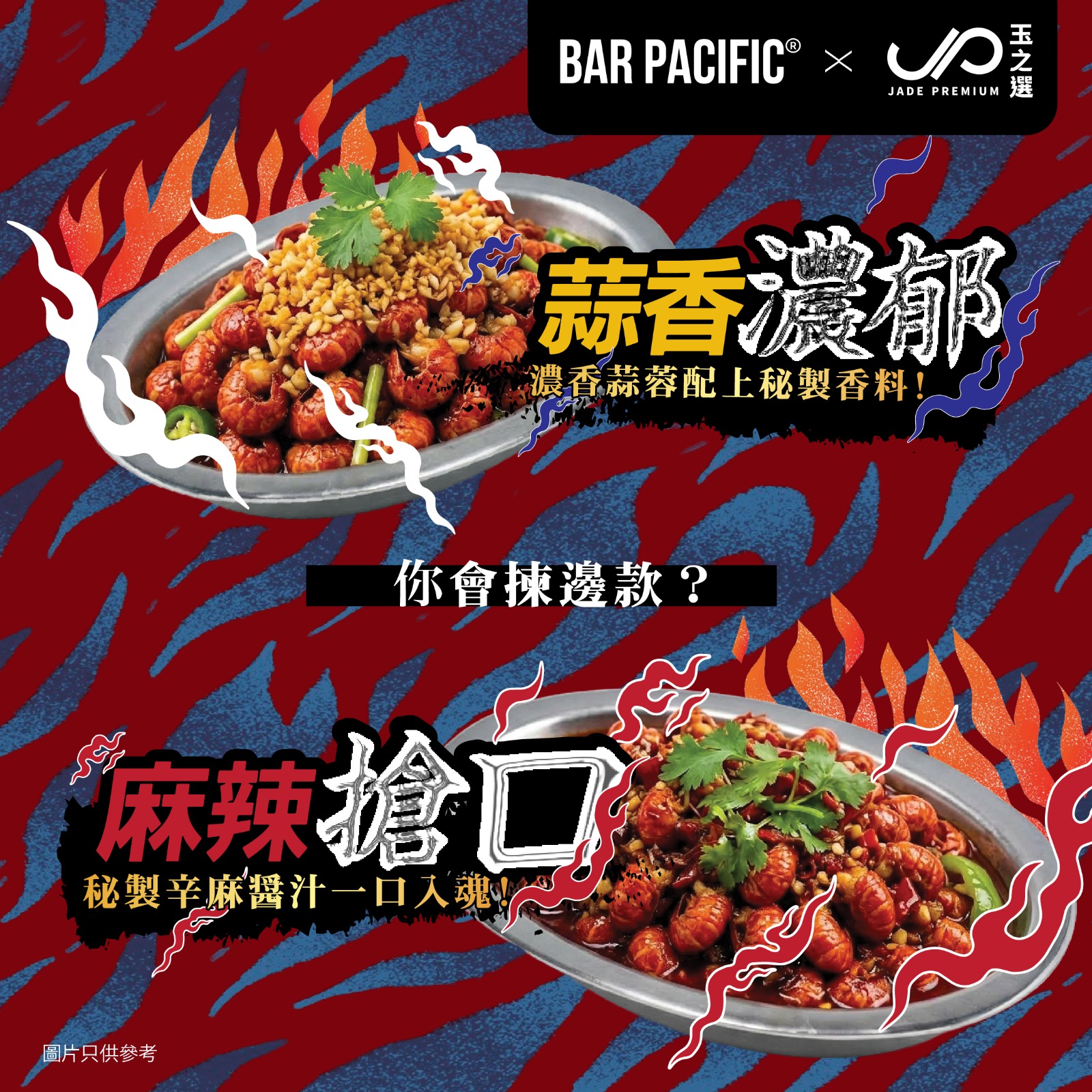
While You Hesitate, Huashan Technology’s Crayfish Tails Are Already on Hong Kong Bar Tables.
Bar Pacific — a bar chain giant spread across Hong Kong communities — has officially launched “Garlic Crayfish Tails” and “Spicy Crayfish Tails” sets.
Why crayfish? Because the demand from the “Mainland palate” is real: at that price, it is no burden within Hong Kong bar spending, costing little more than a plate of chips, yet delivering satisfaction on a completely different scale. The tails need no preparation and are ready in five minutes after heating. Mainland expatriates who want a drink and a chat after work are astonished to find that in a bar in a foreign city, they can actually taste authentic home flavours. A plate of crayfish soothes the homesick soul late at night.
Quality Mainland supply chain + Hong Kong channels = a win-win
Light social settings such as bars provide an excellent foothold for Mainland prepared dishes that do not rely on a back kitchen. The liquid-nitrogen freshness-locked crayfish tails supplied by Huashan Technology are ready in five minutes after heating, greatly reducing labour and waste.
At HK$68 per portion, it is a highly cost-effective “traffic magnet” for Hong Kong bar late-night snacks; paired with a few beers, average spend per customer rises effortlessly.
For merchants, entering Hong Kong’s largest bar chain directly is equivalent to completing brand endorsement through the channel. Reaching Hong Kong end consumers directly as a “Qianjiang origin brand” is a key leap from upstream supply chain to brand premium. Quality Mainland supply chain + mature Hong Kong channels — however you calculate it, it is a win-win.
Hong Kong drifters want to satisfy their cravings, bars want to increase revenue, and Mainland manufacturers want to go global — the needs of all three parties align on a plate of crayfish.

Channel Map: Bars, Late-Night Snacks and Takeaways Are Ideal Scenarios for Mainland Food Entering Hong Kong
When it comes to going global in Hong Kong, the first reaction of most Mainland food manufacturers is: get into supermarkets, or supply restaurants. These channels are of course good, but the thresholds are extremely high, payment periods are long, and competition is fierce.
Many people overlook the true underlying character of Hong Kong’s night economy — bars, late-night snacks and takeaways.
Hong Kong people have a rich nightlife, and Hong Kong drifters need socialising. In traditional Hong Kong bar consumption scenarios, bar snacks have long been dominated by fried foods, chips and chicken wings, lacking freshness and strong flavours. Drinking beer and eating crayfish in a bar not only satisfies the homesick stomachs of Hong Kong drifters, but also gives local Hong Kong people a brand-new entertainment experience.
It is now the National Day Golden Week. If you happen to be in Hong Kong, do not just visit the sights — go to Bar Pacific in the evening and order a portion of crayfish. See how Hong Kong drifters pair it with drinks, and see what Hong Kong bars are selling and what they still lack. This trip is both a holiday and the cheapest market research you can do.
The Case Is Very Successful, but Mainland Food Enterprises That Can Truly Enter Hong Kong Are Few and Far Between.
It is not that products are inadequate. On the contrary, the Mainland never lacks good products — what it lacks is the systemic capability to deliver products onto Hong Kong shelves and dining tables.
Compliance access for Hong Kong-bound food, inspection and quarantine, cold-chain logistics, channel matchmaking and pricing implementation — every link has thresholds, and every link discourages enterprises going it alone.
If you are a food business owner confident in your products, ask yourself these three questions:
Your product quality fully meets standards, but have you figured out the access qualifications and inspection and quarantine procedures for Hong Kong-bound ingredients?
Hong Kong’s bars, late-night snack outlets and retail channels are right in front of you — do you know who to talk to, how to negotiate, and on what terms you can enter?
From factory gate to Hong Kong shelf, can you balance the cold-chain and pricing accounts?
If any of these questions gives you a moment’s hesitation, that is entirely normal.
Because going global is never as simple as “shipping the goods over”. It is a whole systemic campaign of compliance access, cold-chain logistics and channel deployment — and almost no enterprise can build this system from scratch on its own.
What you need is a partner who truly understands the Hong Kong market and can deliver results on the ground.
Hong Kong’s food trend is not in the future tense; it is in the present continuous. As for crayfish, someone has already made the first move. Will the next Mainland flavour to reach Hong Kong dining tables be your product?
The door to the Hong Kong market is already open. Jade Premium is here to pave the road — all that is missing is you walking in.